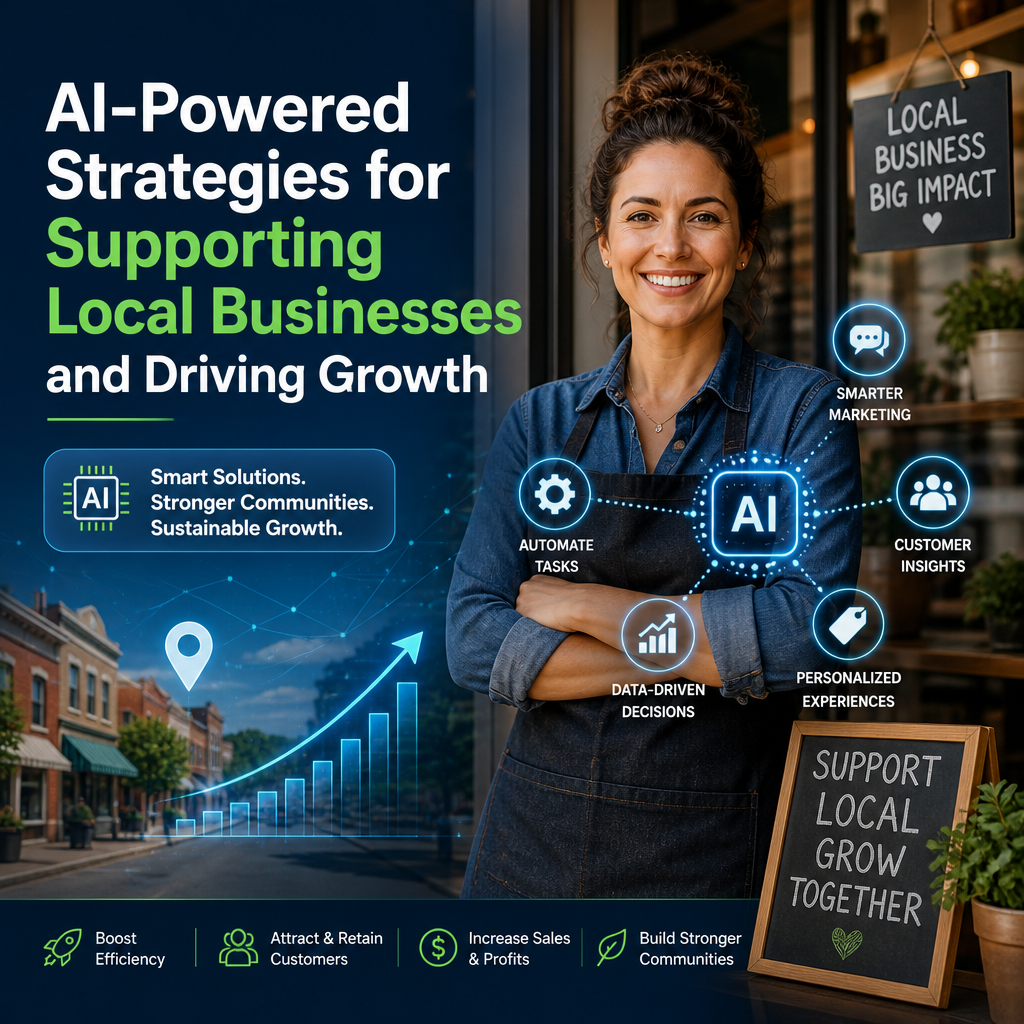
AI-Powered Strategies for Supporting Local Businesses and Driving Growth
AI-Powered Strategies for Supporting Local Businesses
Artificial intelligence is no longer limited to large corporations with extensive technology budgets. Today, local businesses can use AI-powered tools to improve marketing, customer service, operations, and decision-making. These technologies help small companies work more efficiently while creating stronger relationships with the communities they serve.
The key is not to replace the personal touch that makes local businesses special. Instead, AI can support owners and employees by handling repetitive tasks, revealing useful insights, and helping them respond to customers more effectively.

Improve Local Marketing
One of the most practical uses of AI is creating more relevant and consistent marketing content. Small business owners often struggle to find time for social media, email campaigns, blog posts, and online advertising. AI tools can help generate ideas, draft captions, organize content calendars, and adapt messages for different platforms.
For example, a neighborhood bakery might use AI to develop social media posts around seasonal products, local events, or customer favorites. A home repair company could create helpful articles answering common questions about maintenance and renovations.

AI can also help businesses personalize their marketing by identifying customer interests and behaviors. Rather than sending the same message to everyone, companies can promote products, services, or offers that are more likely to appeal to specific groups.
Strengthen Local Search Visibility
Appearing in local search results is essential for attracting nearby customers. AI can support local search optimization by helping businesses:

- Identify commonly searched local phrases
- Improve business descriptions and service pages
- Create answers to frequently asked questions
- Develop content focused on community needs
- Monitor reviews and online mentions
Businesses should still ensure that all information is accurate, useful, and written in a natural voice. AI-generated content works best when combined with local knowledge and real examples.
Enhance Customer Service
Fast, helpful communication can make a major difference in a customer’s decision to choose one business over another. AI-powered chatbots and virtual assistants can answer basic questions at any time, including inquiries about store hours, pricing, availability, appointments, and delivery options.
This does not mean customers should be forced to interact with automated systems. A well-designed AI assistant should provide quick answers while making it easy to connect with a human employee when a question is complex or sensitive.
AI can also help organize customer support requests. By identifying common issues and directing messages to the right team member, it reduces delays and allows staff to focus on problems that require personal attention.
Make Better Business Decisions
Many local businesses collect valuable information through sales records, websites, social media, and customer feedback but do not have the time or expertise to analyze it. AI can turn this data into practical insights.
For instance, AI tools may reveal:
- Which products sell best during specific seasons
- When customer demand is highest
- Which promotions generate the most visits
- What complaints appear most often
- Which marketing channels bring in loyal customers
These insights can help owners make informed decisions about inventory, staffing, pricing, and advertising. Instead of relying only on instinct, business leaders can combine experience with timely data.
Streamline Daily Operations
Administrative work can consume hours that could otherwise be spent serving customers. AI can assist with appointment scheduling, invoice organization, inventory tracking, email sorting, and document preparation.
A small salon, for example, might use an AI scheduling system to reduce missed appointments and fill open time slots. A local retailer could use demand forecasting to avoid overstocking slow-moving products while keeping popular items available.
Automation should be introduced thoughtfully. Businesses should begin with repetitive, low-risk tasks and evaluate the results before expanding to more advanced applications.
Preserve the Human Connection
The greatest strength of a local business is often its personal relationship with customers. AI should support that relationship, not weaken it. Business owners should be transparent when customers are interacting with automation and provide clear access to human assistance.
It is also important to protect customer privacy. Companies should understand how AI tools collect, store, and use information. Choosing reputable providers, limiting unnecessary data collection, and reviewing automated decisions can help maintain trust.
Start Small and Measure Results
Local businesses do not need to adopt every new AI tool at once. A practical approach is to identify one challenge, test a focused solution, and measure the outcome.
Possible starting points include:
- Automating frequently asked questions
- Creating a monthly content calendar
- Analyzing customer reviews
- Improving appointment scheduling
- Forecasting inventory needs
AI-powered strategies can give local businesses more time, clearer insights, and stronger customer engagement. When used responsibly and combined with genuine community knowledge, AI becomes a valuable partner in building sustainable local growth.